


AI for Education
Members
HE
Summary
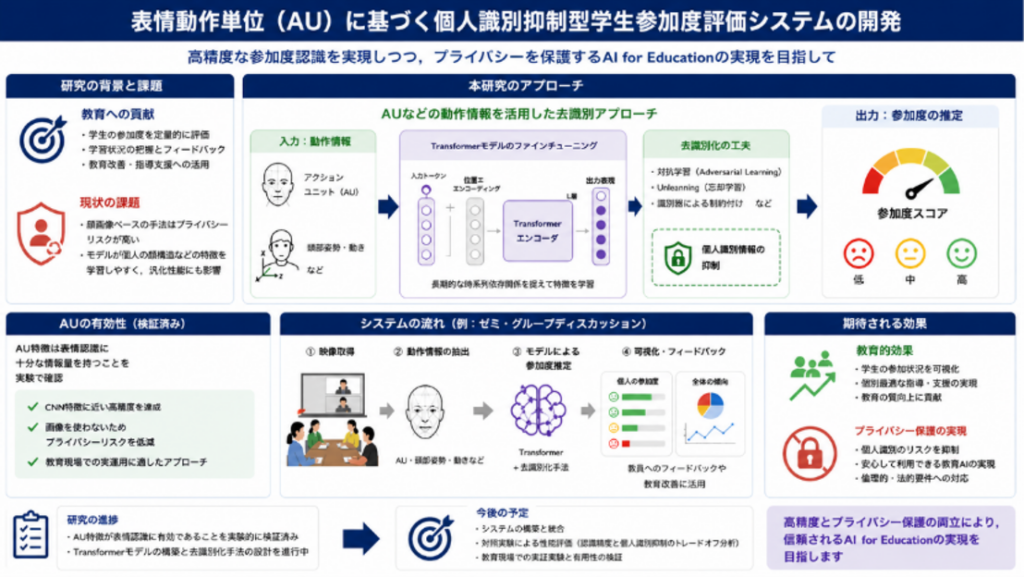
Recognition accuracy and privacy preservation are two critical challenges in the field of facial expression recognition. As deep learning models continue to achieve higher performance, reducing their reliance on identity-related features while maintaining high accuracy has become an increasingly important research issue. On one hand, models trained on facial images tend to capture identity-specific structural information, which may negatively affect generalization. On the other hand, in real-world applications—especially in educational settings—privacy concerns impose strict constraints on system design. In the context of “AI for Education”, assessing student engagement during seminars or group meetings plays a significant role in understanding learning states, providing feedback, and improving teaching strategies. However, approaches based on raw facial images introduce substantial privacy risks, limiting their practical deployment. Therefore, developing methods that enable reliable engagement recognition without relying on identifiable facial information is of great importance.
Previous studies suggest that using motion-based features such as facial Action Units (AUs) and head pose, instead of directly applying convolutional neural networks (CNNs) on images, can reduce the model’s dependence on identity-related features, thus contributing to de-identification. Nevertheless, recent findings indicate that even AU-based representations may still encode identity information to some extent.
To address this issue, this study aims to develop a student engagement recognition system for seminar scenarios by leveraging AU and related motion features. A Transformer-based model will be fine-tuned, incorporating de-identification strategies such as adversarial learning or machine unlearning, to achieve a balance between recognition performance and privacy preservation. Preliminary experiments have confirmed that AU features contain sufficient information for expression recognition tasks. Future work will focus on building a complete system and conducting comparative experiments to evaluate the trade-off between accuracy and identity leakage.